
Menu
PLM X ERP X QMS: What are the differentials and their benefits?
Does your company need an ERP system? A system to support the quality management (QMS)? Or a PLM system?
This question is more common than it seems and choosing the wrong one can lead to rework, disconnected processes, and wasted investment.
In the automotive industry, where engineering, quality, and production need to operate in an integrated manner, understanding the difference between PLM, ERP, and QMS is essential to structuring a modern and competitive operation.
In this article, we’ll shed light on the role of each system and show why many businesses need more than just a traditional ERP.
What is ERP?
ERP (Enterprise Resource Planning) is the system responsible for the administrative and operational management of the company.
It controls:
- Financial
- Purchases
- Stock and Inventory
- Production Planning and Control
- Billing
- General Resources
- Costs
ERP is essential for business management, but it was not created to manage product development by engineering to ensure product quality and reliability.
Common limitations:
- Doesn’t control project versions
- Does not manage the tasks in product development
- Does not integrate core tools in the APQP development
- Does not organize technical changes with traceability
What is QMS?
QMS (Quality Management System) is the system aimed at managing the quality system.
It usually covers:
- Handling of non-conformities
- Corrective and preventive actions
- Quality management system audits
- Quality documents and records
- Quality Metrics and Indicators
- Management of quality control systems/devices
The quality system management is of huge importance for the business, but most of the systems intended for the QMS work in isolation from the engineering that develops the manufacturing products and processes, especially when it comes to the automotive, aeronautical and even home appliances sectors.
Common limitations:
- Doesn’t connect core tools in product development
- Does not integrate technical changes with impacts on production
- Does not provide a complete view of the product lifecycle from concept to end-of-life in the field.
What is PLM?
PLM (Product Lifecycle Management) is the system that manages the complete product lifecycle, from conception to disposal of the product after its useful life.
It connects:
- Software primarily dedicated to Product Engineering
- Management of the BoM (Bill of Material)
- Technical changes to the product and applications
- History traceability
- Product documentation, drawings and specification
- Strategies for disposal, recycling, or replacement with new products.
Among most systems in the automotive industry, PLM becomes the strategic center of technical operation in engineering.
Comparison of Systems dedicated to ERP vs QMS vs PLM
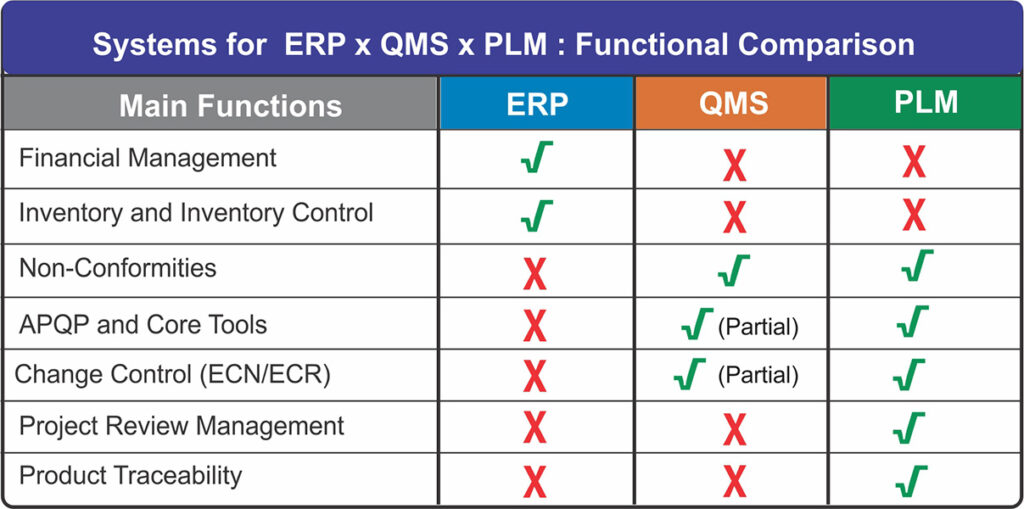
Practical conclusion: ERP takes care of the company’s operations. QMS takes care of the quality system. PLM takes care of the product life cycle from concept to end-of-life in the field.
What system does your industry really need?
If your company:
- Develops its own product
- Must meet IATF 16949 standard
- Develops the product/process according to the APQP Core Tools and IATF16949 standard requirements
- Handles multiple engineering reviews
- Avoids rework due to miscommunication between areas
In this case, ERP and QMS systems are not enough, because in the automotive industry we need a system that connects engineering, quality and production in a structured way and according to specific criteria of the sector.
Where ISOQualitas PLM comes in?
ISOQualitas PLM was developed specifically for the automotive industry.
It complies and integrates:
- Project Planning and Deadline Management
- Application and integration of APQP Core Tools, including the product approval processes (PPAP/VDA2) digitally
- Management and workflow of engineering change approvals (ECN/ECR)
- DFMEAs and PFMEAs connected with Control Planes, Work Instructions and verifiable through RFMEA (Reverse FMEA) during mass production.
- Integrated corrective and preventive actions
- Application of Methodology for Problem Solving (Global 8D)
- Full traceability for IATF 16949 audits
A PLM system is not a substitute for ERP. It complements and structures what ERP does not achieve: the product lifecycle.
Digital transformation in industry doesn’t mean having more systems. It means having the right systems and strategically integrated
An ERP system organizes the operations of the business in terms of resources and planning of production and delivery. QMS controls the quality system as a whole.
A PLM system ensures that the product is developed to applicable standards, modified and delivered with the required quality and reliability and with full traceability of the product life cycle.
If your company intends to reduce failures, accelerate new product launches and gain technical maturity, then understanding this difference is the first step.
And ISOQualitas PLM is made for just that.
Recent Posts
Archive
Categories
Categories
- APQP and Core Tools (4)
- APQP e Core Tools (2)
- Automotive Audits (2)
- Automotive Cybersecurity (1)
- Automotive Digital Transformation (1)
- Automotive Process Engineering (2)
- Automotive Quality and Compliance (1)
- Automotive Quality Management (8)
- Automotive Risk and Quality Management (1)
- Blog (2)
- Digital Transformation in Industry (6)
- Engenharia de Processos Automotivos (2)
- Engenharia de Produto e Processos (2)
- Engineering and Quality (1)
- ESG in the Automotive Sector (1)
- Future of Work (1)
- Gestão da Qualidade Automotiva (2)
- IATF 16949 (3)
- IATF 16949 Compliance (1)
- Industrial Automation (2)
- Industrial Efficiency (1)
- Industrial Technology and PLM (2)
- Industry 4.0 (2)
- Manufacturing Software Solutions (1)
- News (20)
- Nonconformity Reduction (1)
- Product and Process Engineering (4)
- Product Development and Engineering (3)
- Product Lifecycle Management (2)
- Product Lifecycle Management (PLM) (4)
- Qualidade Automotiva (2)
- Qualidade e Controle Estatístico de Processos (2)
- Quality and Compliance Management (1)
- Quality and Technology (2)
- Quality Management (4)
- Quality Management in Industry (1)
- Recall Prevention (1)
- Risk Analysis and Corrective Actions (1)
- Software-Defined Vehicles (SDVs) (1)
- Statistical Process Control and Quality (1)
- Sustainability in Industry (1)
- Technological Transformation (2)
Tags
Tags
Automotive APQP
automotive core tools
automotive cybersecurity
automotive FMEA
automotive industry 4.0
automotive nonconformities
automotive PLM
automotive ppap
automotive product engineering
automotive quality
automotive quality software
automotive risk management
automotive spc
automotive traceability
Continuous improvement in the automotive industry
corrective and preventive actions
dfmea pfmea
digital FMEA
engineering and quality integration
engineering change management
Global 8D
IATF 16949
IATF 16949 and ESG
IATF 16949 compliance
industrial digital transformation
industrial erp
Industrial performance indicators (KPIs)
industrial risk management
Industry 4.0 and quality
ISOQualitas PLM
não conformidades automotivas
pfmea
problem solving
process control
process traceability
product engineering automotive
product lifecycle management
quality KPIs
quality management system
quality management system qms
robots and workforce
root cause analysis
sistema de gestão da qualidade
top QMS automotive 2026
vehicle digital safety