
Menu
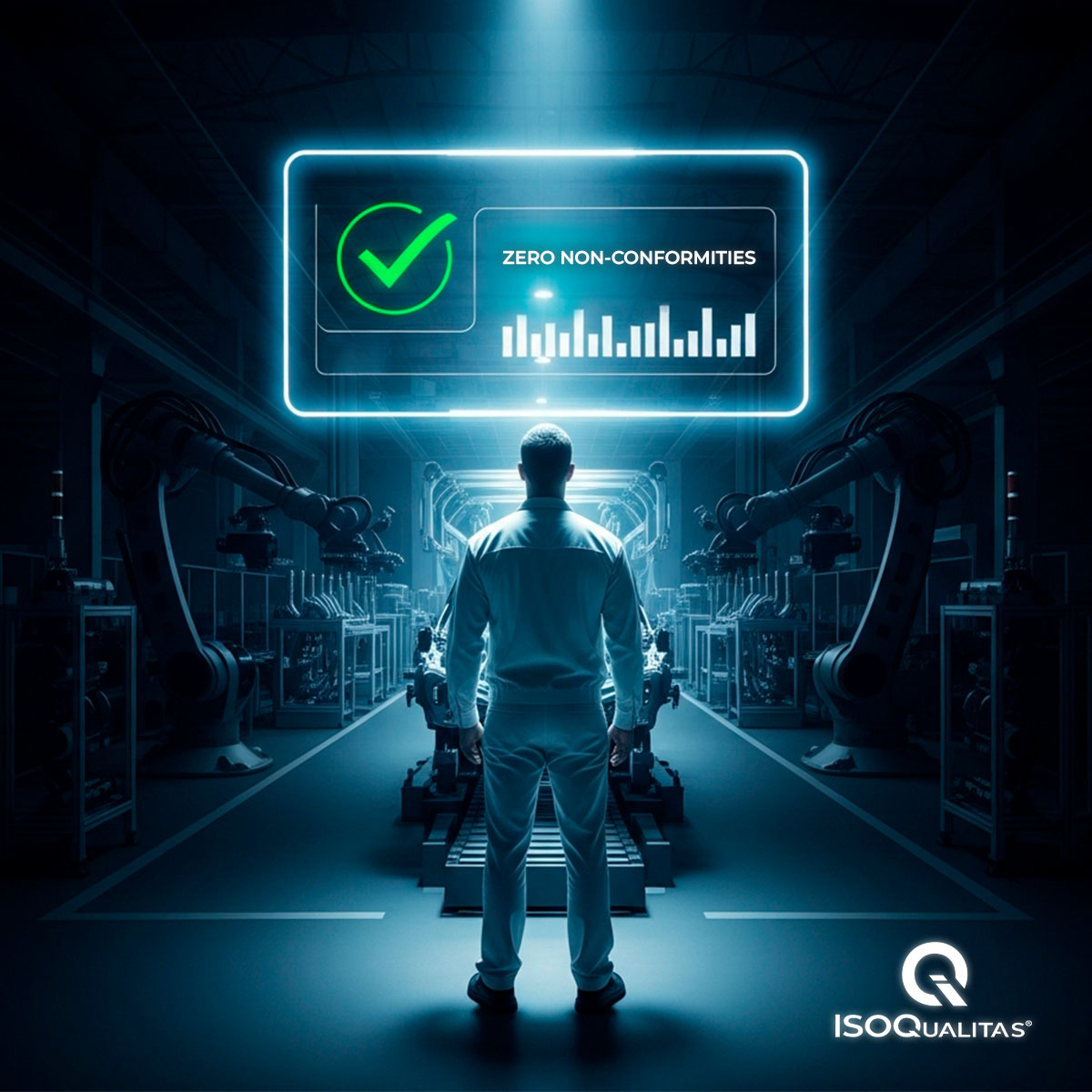
In the automotive industry, a single deviation in quality can compromise an entire production batch and, in more serious cases, generate losses with recalls, rework, and loss of customer agreements. Therefore, reducing non-conformities is not only a goal of the quality management system, but a strategy for survival and business growth.
In this article, you will understand how automotive quality management software, such as ISOQualitas PLM, helps you eliminate failures before they happen and make your production more reliable and competitive.
1. What are non-conformities and why are they so expensive?
Non-conformities (NCs) are any deviation from a specified requirement: whether it is an out-of-tolerance measurement, an assembly failure, absence of documentation, or any other error that may compromise the quality, safety, reliability, or product traceability.
The impacts go far beyond the quality sector:
- Production Line Shutdowns
- Delivery delays to the customer
- Loss of materials and labor (scrap/rework)
- Contractual penalties
- Risk of recall and damage to brand image
- And most worryingly, many companies can't pinpoint the source of the failure accurately because they still work with manual processes, scattered spreadsheets, or disconnected systems with no integration between product data and manufacturing processes.
2. How does a quality system supported by software help to avoid non-conformities?
Adequate software for automotive quality management must act before, during and after the occurrence of a NC. ISOQualitas PLM, for example, offers functionalities that cover all these steps in an integrated way:
Before CN: Structured prevention
- Quality planning with digital APQP
- Identification and control of risks with Project and Process FMEAs
- Registered and process-linked trainings
- Already defined and traceable process and inspection controls
During the process: Monitoring and control
- Real-time recording of deviations and alerts in production
- Integration with quality indicators (PPM, Pp/PpK, Cp/Cpk, etc.)
After the NC: Correction and Lessons Learned
- Complete record of non-compliance, with origin (Causes) and impact (Effects)
- Tools for root cause analysis (5 Whys, Ishikawa, etc.)
- Corrective and preventive actions with approval workflow
- Verification of effectiveness and auditable track record and extension of actions to similar products/processes.
3. Which areas of the company benefit from this integrated management?
Although the direct impact is on quality, the gains are perceived throughout the production chain:
- Engineering: can track changes and risks in real time
- Production: Receives up-to-date instructions and controls deviations faster
- Logistics: avoids rework and returns due to quality failures
- Commercial: wins concrete arguments about reliability and performance
- Board: Has visibility into data and can make decisions based on facts
4. Real benefits for automotive operation
- Implementing software like ISOQualitas PLM reduces non-conformities and delivers clear gains:
- Less rework and waste
- More agility and effectiveness in corrective actions
- Increased First Time Quality Compliance Rate
- Faster, hassle-free audits
- Continuous improvement based on data, not assumptions
Non-conformities happen. But when you have integrated, traceable, technology-based processes, they stop being crises and become opportunities for improvement.
With ISOQualitas PLM, your company transforms data into decisions, problems into solid processes, and quality into a competitive advantage. Because in the automotive industry, quality and reliability are not extraordinary attributes, they are the minimum expected.
Recent Posts
Archive
Categories
Categories
- APQP and Core Tools (4)
- APQP e Core Tools (2)
- Automotive Audits (2)
- Automotive Cybersecurity (1)
- Automotive Digital Transformation (1)
- Automotive Process Engineering (2)
- Automotive Quality and Compliance (1)
- Automotive Quality Management (8)
- Automotive Risk and Quality Management (1)
- Blog (2)
- Digital Transformation in Industry (6)
- Engenharia de Processos Automotivos (2)
- Engenharia de Produto e Processos (2)
- Engineering and Quality (1)
- ESG in the Automotive Sector (1)
- Future of Work (1)
- Gestão da Qualidade Automotiva (2)
- IATF 16949 (3)
- IATF 16949 Compliance (1)
- Industrial Automation (2)
- Industrial Efficiency (1)
- Industrial Technology and PLM (2)
- Industry 4.0 (2)
- Manufacturing Software Solutions (1)
- News (20)
- Nonconformity Reduction (1)
- Product and Process Engineering (4)
- Product Development and Engineering (3)
- Product Lifecycle Management (2)
- Product Lifecycle Management (PLM) (4)
- Qualidade Automotiva (2)
- Qualidade e Controle Estatístico de Processos (2)
- Quality and Compliance Management (1)
- Quality and Technology (2)
- Quality Management (4)
- Quality Management in Industry (1)
- Recall Prevention (1)
- Risk Analysis and Corrective Actions (1)
- Software-Defined Vehicles (SDVs) (1)
- Statistical Process Control and Quality (1)
- Sustainability in Industry (1)
- Technological Transformation (2)
Tags
Tags
Automotive APQP
automotive core tools
automotive cybersecurity
automotive FMEA
automotive industry 4.0
automotive nonconformities
automotive PLM
automotive ppap
automotive product engineering
automotive quality
automotive quality software
automotive risk management
automotive spc
automotive traceability
Continuous improvement in the automotive industry
corrective and preventive actions
dfmea pfmea
digital FMEA
engineering and quality integration
engineering change management
Global 8D
IATF 16949
IATF 16949 and ESG
IATF 16949 compliance
industrial digital transformation
industrial erp
Industrial performance indicators (KPIs)
industrial risk management
Industry 4.0 and quality
ISOQualitas PLM
não conformidades automotivas
pfmea
problem solving
process control
process traceability
product engineering automotive
product lifecycle management
quality KPIs
quality management system
quality management system qms
robots and workforce
root cause analysis
sistema de gestão da qualidade
top QMS automotive 2026
vehicle digital safety