
Menu

PPAP in the automotive industry: How to organize and streamline product approvals with the customer
In the automotive industry, the launch of a new product does not depend only on production capacity. Before a part is manufactured to scale, it is necessary to ensure that the entire development and manufacturing process meets the customer’s technical requirements.
It is in this context that the PPAP (Production Part Approval Process) emerges, one of the fundamental elements of APQP’s Core Tools, which are widely used in the automotive sector.
PPAP ensures that the product meets the customer’s requirements through the production process that must be properly planned, validated and documented before the start of serial production. In this article, we will explain the role of PPAP in the automotive industry and how to structure this process in an organized and traceable way.
What is PPAP?
The Production Part Approval Process (PPAP) is a formal approval process used between suppliers and customers to ensure that all engineering and manufacturing requirements have been correctly understood and met.
It is widely used in the automotive sector and is directly associated with the Core Tools defined by the AIAG, being an essential part of the APQP (Advanced Product Quality Planning) methodology.
The purpose of the PPAP is to demonstrate that:
- The product meets engineering requirements
- The production process is stable, capable and properly controlled
- Actual and potential risks have been identified, analysed and kept under control
- Serial production can take place safely and consistently to specifications
This process directly contributes to the quality and reliability of the product, as well as compliance with the requirements of the APQP core tools and IATF 16949 standard.
The PPAP Requirements
The PPAP is composed of 18 requirements that are part of the structured set of documents and technical evidence that prove the robustness of the product and the process, which are derived from the activities of the APQP.
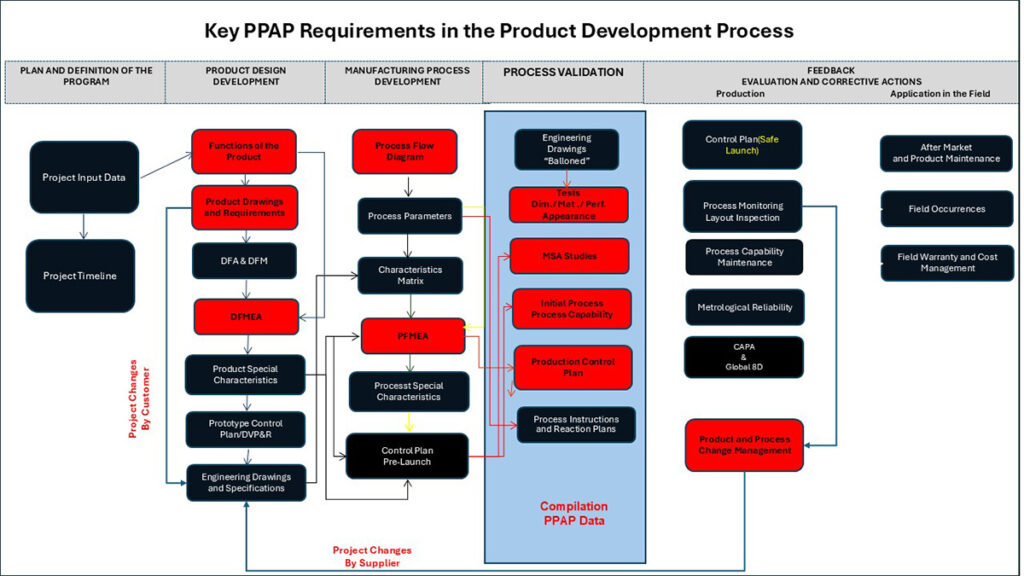
The 18 requirements of the PPAP are:
- Project Records
- Engineering Change Documents, if any
- Customer Engineering Approval, if required
- Design FMEA
- Process Flow Diagram
- Process FMEA
- Process Control Plan
- Measurement Systems Analysis Studies
- Dimensional Results
- Material and performance test results
- Initial Process Capability Studies
- Qualified Laboratory Documentation (If Required)
- Appearance Approval Report, if applicable
- Product Sample
- Master Sample
- Checking Aids, if applicable
- Compliance Records of Specific Customer Requirements
- Certificate of Part Submission (PSW), Bulk Material Checklist, if applicable
These elements must be submitted according to the established submission level (Levels 1 to 5) which demonstrate to the customer that the supplier has a controlled process prepared to meet the requirements during production.
Common challenges in PPAP management
Despite being an essential process, many companies still face difficulties in organizing and managing information related to PPAP.
Some common challenges include:
- Documents scattered across spreadsheets or local folders
- Difficulty in tracking engineering reviews
- Lack of integration between engineering, quality and production
- Manual document versioning
- Difficulty locating evidence during audits
These issues can lead to delays in customer approval and rework in the new product launch process.
The importance of integration with APQP Core Tools
PPAP should not be treated as an isolated process. It is part of a larger product quality planning framework.
Within APQP, PPAP is connected to several important tools, such as:
- DFMEA (Design Failure Mode and Effects Analysis), if applicable
- Process Flow Diagram
- PFMEA (Process Failure Mode and Effects Analysis)
- Process Control Plan
- Studies of Measurement Systems (MSA)
- Initial Process Capability Studies (Pp e PpK)
- Product and process validations (Dimensional, Material, Performance) and appearance, if applicable
When these tools are integrated, the company is able to maintain greater control over product development, reduce product approval time, and reduce and control the risks of non-conformities throughout the product lifecycle.
How does ISOQualitas PLM contribute to PPAP management?
ISOQualitas PLM was developed to support product lifecycle management and the integration between engineering, quality, and production.
In the context of PPAP, the system allows:
- Integration of APQP Core Tools in a digital environment
- structured management of DFMEA and PFMEA
- Connection between control plans, work instructions and production processes
- Control of engineering revisions and technical documentation
- Approval management and workflow for client submission
- Full traceability for audits to IATF 16949
- In this way, PPAP is no longer just a set of documents and becomes part of an integrated product management process.
PPAP is a key step in ensuring that new products are introduced into production with quality, safety, and compliance with customer requirements.
When well-structured and integrated with the other Core Tools of APQP, it contributes to reducing risks, improving communication between areas and increasing the reliability of the production process.
With the support of specialized platforms such as ISOQualitas PLM, companies are able to better organize their technical information, ensure traceability, and conduct the product approval process more efficiently.
This strengthens the company’s operational maturity and contributes to meeting the increasingly stringent requirements of the automotive industry.
Recent Posts
Archive
Categories
Categories
- APQP and Core Tools (4)
- APQP e Core Tools (2)
- Automotive Audits (2)
- Automotive Cybersecurity (1)
- Automotive Digital Transformation (1)
- Automotive Process Engineering (2)
- Automotive Quality and Compliance (1)
- Automotive Quality Management (8)
- Automotive Risk and Quality Management (1)
- Blog (2)
- Digital Transformation in Industry (6)
- Engenharia de Processos Automotivos (2)
- Engenharia de Produto e Processos (2)
- Engineering and Quality (1)
- ESG in the Automotive Sector (1)
- Future of Work (1)
- Gestão da Qualidade Automotiva (2)
- IATF 16949 (3)
- IATF 16949 Compliance (1)
- Industrial Automation (2)
- Industrial Efficiency (1)
- Industrial Technology and PLM (2)
- Industry 4.0 (2)
- Manufacturing Software Solutions (1)
- News (20)
- Nonconformity Reduction (1)
- Product and Process Engineering (4)
- Product Development and Engineering (3)
- Product Lifecycle Management (2)
- Product Lifecycle Management (PLM) (4)
- Qualidade Automotiva (2)
- Qualidade e Controle Estatístico de Processos (2)
- Quality and Compliance Management (1)
- Quality and Technology (2)
- Quality Management (4)
- Quality Management in Industry (1)
- Recall Prevention (1)
- Risk Analysis and Corrective Actions (1)
- Software-Defined Vehicles (SDVs) (1)
- Statistical Process Control and Quality (1)
- Sustainability in Industry (1)
- Technological Transformation (2)
Tags
Tags
Automotive APQP
automotive core tools
automotive cybersecurity
automotive FMEA
automotive industry 4.0
automotive nonconformities
automotive PLM
automotive ppap
automotive product engineering
automotive quality
automotive quality software
automotive risk management
automotive spc
automotive traceability
Continuous improvement in the automotive industry
corrective and preventive actions
dfmea pfmea
digital FMEA
engineering and quality integration
engineering change management
Global 8D
IATF 16949
IATF 16949 and ESG
IATF 16949 compliance
industrial digital transformation
industrial erp
Industrial performance indicators (KPIs)
industrial risk management
Industry 4.0 and quality
ISOQualitas PLM
não conformidades automotivas
pfmea
problem solving
process control
process traceability
product engineering automotive
product lifecycle management
quality KPIs
quality management system
quality management system qms
robots and workforce
root cause analysis
sistema de gestão da qualidade
top QMS automotive 2026
vehicle digital safety