

R-FMEA (Reverse FMEA): How to verify that the controls defined in PFMEA are actually applied in the process
In the automotive industry, identifying risks during process development is critical. However, there is an equally important issue: what was defined in PFMEA is actually happening in the manufacturing process?
It is precisely at this point that R-FMEA – Reverse FMEA (Reverse FMEA) gains importance.
While PFMEA starts from the process analysis to identify potential failure modes, causes, effects, and controls, R-FMEA makes a complementary move: goes to the actual process to verify that the foreseen risks, the controls established and the conditions considered in the analysis correspond to what occurs in production.
This verification allows the identification of differences between the documented process and the executed process, new risks, changes not incorporated into the documentation, and opportunities to update the PFMEA and the Control Plan.
More than a document review, R-FMEA brings risk management closer to the reality of the factory floor.
What is R-FMEA – Reverse FMEA?
R-FMEA is a verification approach carried out directly in the manufacturing process, used to confront the real conditions of production with the risks and controls registered in the PFMEA.
Its purpose is not to replace PFMEA or to re-perform the entire risk analysis.
The logic is to verify, in practice, whether what was foreseen is still valid.
During an R-FMEA, the team can observe, for example:
- whether the process steps match the Process Flow Diagram;
- whether the controls provided for in PFMEA are effectively implemented;
- whether the controls defined in the Control Plan are executed as established;
- whether special features are being adequately controlled;
- whether the measurement methods and devices used are as intended;
- whether there are process conditions capable of generating new modes or causes of failure;
- whether changes made in production have been incorporated into the related documents;
- whether reaction plans are known and applied when a deviation occurs.
R-FMEA therefore transforms risk analysis into a continuous process of verification, learning and updating.
PFMEA e R-FMEA: What’s the difference?
Despite being directly related, PFMEA and R-FMEA fulfill different functions.
PFMEA – Process Failure Mode and Effects Analysis is used to analyze in advance the risks associated with the manufacturing process.
The team evaluates operations, potential failure modes, effects, causes, prevention and detection controls, and defines the actions needed to reduce risks.
R-FMEA, on the other hand, starts from actual production.
Instead of just asking, “What can go wrong in this process?” the team also goes on to ask: “Is the process happening in the way we considered when we prepared the PFMEA?”
This change in perspective is important because a production process is dynamic.
Equipment is changed, devices are replaced, parameters are adjusted, suppliers can change, working methods evolve and new conditions can arise throughout serial production.
If these changes are not reflected in the risk analysis, PFMEA may no longer adequately represent the current process.
How R-FMEA is performed in the manufacturing process?
R-FMEA should involve direct observation of the process and participation of a multidisciplinary team, gathering knowledge from areas related to the product and manufacturing.
Before verification, it is important to consult the documents applicable to the process, such as:
PFMEA → Process Flow Diagram → Control Plan → Work Instructions → Production and Quality Records
With this information, the team can go through operations and compare what is documented with what is actually being performed.
1. Observe the actual operation
The first step is to monitor the process in operation.
The objective is to understand how the operation occurs effectively, considering the machine, operator, devices, materials, parameters, inspection methods, movement and other relevant conditions.
2. Compare the process with PFMEA
The team verifies that the recorded failure modes, causes, and controls remain consistent with the observed condition.
At this point, important questions may arise:
Are there any failure conditions that have not been considered?
Has any registered cause ceased to exist?
Is there a possible new cause resulting from any change in the process?
Prevention and detection controls are actually in place?
3. Check the Control Plan
The planned controls need to be confronted with the execution.
This includes verifying controlled characteristics, specifications, measurement method, frequency, sample size, records, and reaction plans.
The relationship with the previous article is direct: Control Plan in the Automotive Industry: How to Ensure Defined Controls Are Applied in Production, while R-FMEA helps to verify that this relationship remains consistent in the actual process.
4. Identify new risks and opportunities for improvement
Direct observation can reveal conditions that were not evident during the original preparation of the PFMEA.
For example, the possibility of incorrect assembly, positioning errors, inappropriate adjustments, failures related to material handling, risks arising from operator intervention or conditions that make it difficult to detect a non-conformity can be identified.
These findings should be technically analyzed and, where applicable, incorporated into risk management.
5. Record evidence and define actions
R-FMEA should not end with just a list of evidence.
When divergences or new risks are identified, it is necessary to define those responsible, actions and deadlines, in addition to monitoring their implementation.
Depending on the outcome, it may be necessary to review the related documents.
R-FMEA may cause the revision of the PFMEA and the Control Plan?
Yes! This is one of the most relevant points of the methodology.
When R-FMEA identifies a condition that is different from the one previously considered, the organization must assess the impact on the documentation and controls of the process.
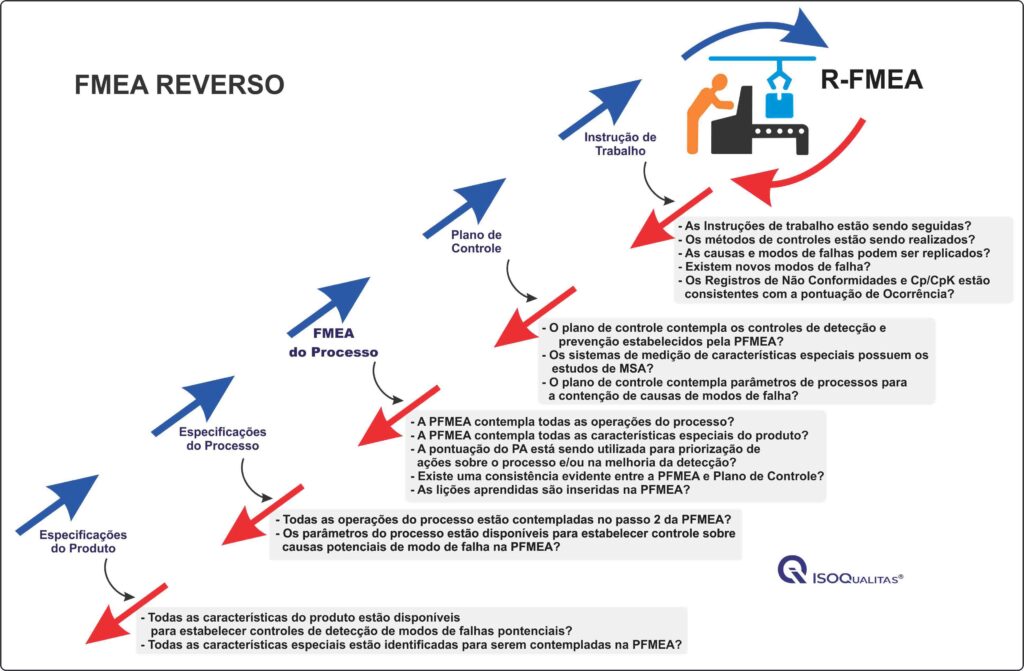
The relationship can be represented as follows:
Real process → R-FMEA → identification of divergences or new risks → review of the PFMEA → review of the Control Plan → implementation and monitoring of actions
This creates a feedback loop.
The PFMEA is no longer a document prepared only during development and starts to incorporate the learning obtained throughout the life of the process.
This logic also reinforces the importance of traceability of changes, allowing you to identify what has changed, why it has changed, which risks have been impacted, and which controls have needed to be updated.
What is the relationship between R-FMEA, PFMEA and Control Plan?
Yes! This is one of the most relevant points of the methodology.
When R-FMEA identifies a condition that is different from the one previously considered, the organization must assess the impact on the documentation and controls of the process.
The relationship can be represented as follows:
Real process → R-FMEA → identification of divergences or new risks → review of the PFMEA → review of the Control Plan → implementation and monitoring of actions
This creates a feedback loop.
The PFMEA is no longer a document prepared only during development and starts to incorporate the learning obtained throughout the life of the process.
This logic also reinforces the importance of traceability of changes, allowing you to identify what has changed, why it has changed, which risks have been impacted, and which controls have needed to be updated.
What is the relationship between R-FMEA, PFMEA and Control Plan?
These tools should not function as stand-alone activities and documents.
There is a direct relationship between them:
PFMEA Identifies and Assesses Process Risks.
↓
Control Plan Transforms relevant risks and characteristics into controls applicable to production.
↓
Manufacturing Process (Work Instructions) Performs the defined operations and controls.
↓
R-FMEA Verifies in the actual process whether documented risks and controls remain consistent and identifies new conditions.
↓
Update of the PFMEA and Control Plan Incorporates the learnings and changes identified.
This integration allows risk management to follow the evolution of the process throughout serial production.
When to perform a Reverse FMEA?
The periodicity and criteria should consider the requirements applicable to the organization, the customer, and the process.
In addition to the planned checks, certain events may indicate the need for a new evaluation, such as:
- Product or process changes;
- Installation or modification of equipment and devices;
- Raw material or supplier changes;
- Changes to the process instructions
- Changes in measurement or control methods;
- Occurrence of internal or external non-conformities;
- Customer complaints;
- Audit Results;
- Changes or additions of special characteristics;
- Relevant changes in process parameters;
- Recurrence of failures;
- Implementation of corrective actions.
Thus, R-FMEA can be used not only as a periodic activity, but also as an instrument to verify whether changes and learning have been adequately incorporated into risk management.
R-FMEA and continuous improvement
One of the biggest benefits of Reverse FMEA is in the learning obtained from the actual process.
Not all manufacturing conditions can be anticipated during development.
Production generates important information about variations, interventions, operational difficulties, equipment behavior, quality issues, and effectiveness of controls.
When this information is returned to PFMEA, the organization strengthens its knowledge base and improves future analysis.
R-FMEA thus contributes to transforming PFMEA into a living document, connected to the experience accumulated during production.
R-FMEA and problem solving
Reverse FMEA can also relate to problem solving processes.
A non-conformance identified by customer, production or audit may reveal that:
- A cause that had not been considered in the PFMEA;
- The risk had been underestimated;
- A planned control was not being carried out;
- The existing control was not effective enough;
- A process change had not been incorporated into the documentation.
After the analysis and implementation of corrective actions, the learnings must be evaluated in relation to the PFMEA and the Control Plan.
This connection will be especially important in the next theme of our sequence: Global 8D, in which we will be able to delve into the framework used for containment, root cause analysis, implementation of corrective actions, and prevention of recidivism.
Main challenges in the application of R-FMEA
Some difficulties can reduce the effectiveness of Reverse FMEA:
Perform the activity only as a checklist: R-FMEA needs to provoke a critical analysis of the process and not only confirm documentary items.
Outdated PFMEA: comparing the process with a document that no longer represents reality reduces the value of the analysis.
Lack of integration between documents: changes identified in the R-FMEA may require changes in PFMEA, Control Plan, instructions, and other related records.
Lack of follow-up of actions: identifying a divergence without ensuring its treatment does not close the improvement cycle.
Information distributed in different documents and spreadsheets: this makes it difficult to identify the relationships between risks, controls, changes, and evidence.
It is precisely on this last point that integrated information management starts to play an important role.
How can an integrated system support R-FMEA?
The realization of R-FMEA occurs in the manufacturing process, through the observation and technical analysis of the team. An integrated system does not replace this activity.
However, it can support the management of information related to process risks and controls.
ISOQualitas PLM allows you to integrate information related to product and process development, supporting activities such as:
- Management and updating of PFMEA;
- Relationship between risks and controls;
- Integration between PFMEA and Control Plan;
- Management of product and process characteristics;
- Revision Control;
- Traceability of changes;
- Follow-up of actions;
- Maintaining the history of analyses;
- Integration of information related to Core Tools.
In this way, the results obtained during a Reverse FMEA can be incorporated into related documents and processes, reducing the risk of maintaining divergent information between what was planned and what is actually being carried out in production.
Conclusion
R-FMEA expands risk management by bringing the analysis to the environment where the process actually happens.
By comparing the manufacturing process to the PFMEA and Control Plan, the organization can identify divergences, new risks, undocumented changes, and opportunities for improvement.
More than verifying documents, Reverse FMEA creates an important learning cycle:
Plan the controls → execute the process → verify reality → update risks → improve controls.
When PFMEA, Control Plan, R-FMEA and other related information are maintained in an integrated and traceable manner, it becomes easier to preserve coherence between the planned process and production throughout the product life cycle.
ISOQualitas PLM supports this integration by connecting product, process, risk, controls, change, and core information in a structured environment for lifecycle management.
Entre em contato e solicite uma demonstração.
Postagem Anterior
Posts Recentes
Control Plan in the Automotive Industry: How to Ensure Defined Controls Are Applied in Production
SPC in the Automotive Industry: How Statistical Process Control Reduces Variations and Increases Capability
MSA in the Automotive Industry: how to validate measurement systems and avoid analysis errors
FMEA in the automotive industry: how to structure DFMEA and PFMEA according to APQP and IATF 16949 standard
PPAP in the automotive industry: How to organize and streamline product approvals with the customer
Arquivos
Archives
- September 2026
- July 2026
- May 2026
- April 2026
- March 2026
- February 2026
- January 2026
- November 2025
- September 2025
- August 2025
- July 2025
- June 2025
- March 2025
Categorias
Categories
- APQP and Core Tools (4)
- APQP e Core Tools (1)
- Automotive Audits (2)
- Automotive Cybersecurity (1)
- Automotive Digital Transformation (1)
- Automotive Process Engineering (2)
- Automotive Quality and Compliance (1)
- Automotive Quality Management (8)
- Automotive Risk and Quality Management (1)
- Blog (1)
- Digital Transformation in Industry (6)
- Engenharia de Processos Automotivos (1)
- Engenharia de Produto e Processos (1)
- Engineering and Quality (1)
- ESG in the Automotive Sector (1)
- Future of Work (1)
- Gestão da Qualidade Automotiva (2)
- IATF 16949 (3)
- IATF 16949 Compliance (1)
- Industrial Automation (2)
- Industrial Efficiency (1)
- Industrial Technology and PLM (2)
- Industry 4.0 (2)
- Manufacturing Software Solutions (1)
- News (20)
- Nonconformity Reduction (1)
- Product and Process Engineering (4)
- Product Development and Engineering (3)
- Product Lifecycle Management (2)
- Product Lifecycle Management (PLM) (4)
- Qualidade Automotiva (1)
- Qualidade e Controle Estatístico de Processos (1)
- Quality and Compliance Management (1)
- Quality and Technology (2)
- Quality Management (4)
- Quality Management in Industry (1)
- Recall Prevention (1)
- Risk Analysis and Corrective Actions (1)
- Software-Defined Vehicles (SDVs) (1)
- Statistical Process Control and Quality (1)
- Sustainability in Industry (1)
- Technological Transformation (2)
Tags
Tags
audit checklist
automation and productivity
Automotive APQP
automotive core tools
automotive cybersecurity
automotive FMEA
automotive nonconformities
automotive PLM
automotive PLM solution
automotive ppap
automotive product engineering
automotive quality
automotive quality software
automotive risk management
automotive spc
automotive traceability
connected vehicles
corrective and preventive actions
cyber risk management
dfmea pfmea
digital FMEA
engineering change management
ESG in the automotive industry
gestão de riscos automotiva.
Global 8D
IATF 16949
IATF 16949 compliance
industrial digital transformation
industrial erp
Industrial process integration
industrial risk management
industrial sustainability
Industry 4.0 and quality
ISOQualitas automation solutions
ISOQualitas PLM
ISO quality standards
nonconformance management
pfmea
Plano de Controle
process capability
process traceability
product lifecycle management
quality management system
quality management system qms
SDV in automotive industry
Edit Template