
Menu
Control Plan in the Automotive Industry: How to Ensure Defined Controls Are Applied in Production
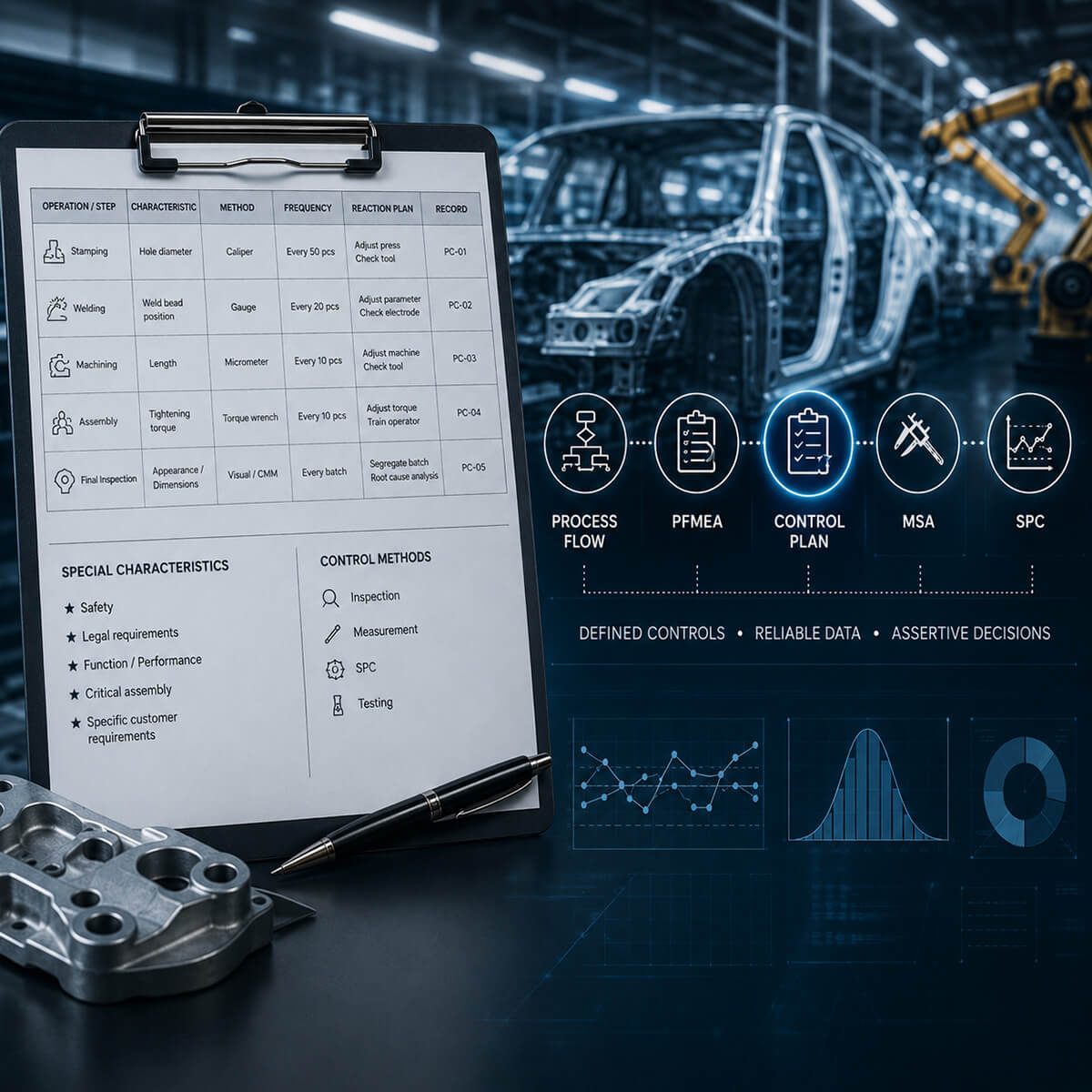
In the automotive industry, identifying risks during the development of a product is only one part of the process. It is necessary to transform these analyses into effective controls, capable of monitoring the characteristics of the product and the process during production.
This is precisely one of the main functions of the Control Plan: to establish in a structured way what should be controlled, how, when, with what method and what action should be taken when the process does not present the expected result.
Integrated with APQP (Advanced Product Quality Planning) and other Core Tools, the Control Plan contributes to the definitions made during development being effectively applied in the production process.
What is a Control Plan?
The Control Plan is a structured document that describes the methods used to control relevant product and process characteristics.
It gathers information needed to guide control activities during production, including:
- Process steps and operations;
- Product and process characteristics to be controlled;
- Special characteristics;
- Specifications and tolerances;
- Measurement methods and equipment;
- Sample size and frequency;
- Control methods;
- Records Required;
- Reaction plans in the face of deviations.
More than recording inspections, the Control Plan must reflect the risks identified during development and establish controls compatible with these risks.
Therefore, its elaboration is directly related to the PFMEA and the Process Flow Diagram.
The relationship between PFMEA, Process Flowchart, and Control Plan
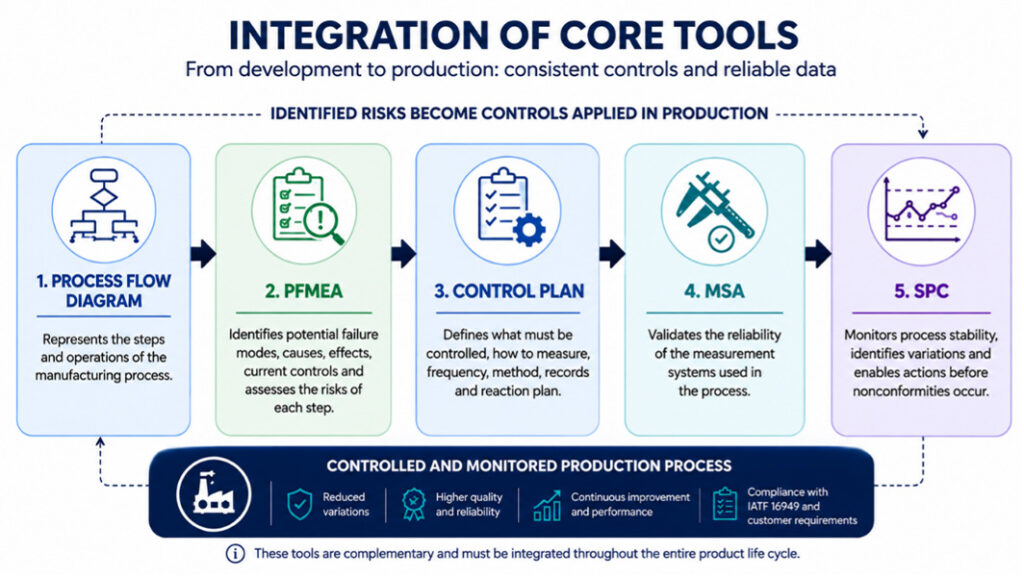
A consistent Control Plan should not be developed in isolation. There is a direct relationship between three important documents: Process Flow Diagram → PFMEA → Control Plan
The Flow Diagram presents the sequence of operations of the production process.
PFMEA (Process Failure Mode and Effects Analysis) analyzes the possible failure modes, their effects, causes, and controls related to these operations.
The Control Plan, on the other hand, transforms part of these analyses into effective monitoring and control activities in production.
If a particular trait poses a relevant risk in PFMEA, for example, it is necessary to assess how this trait will be controlled during manufacturing.
This connection is essential to maintain consistency between what has been identified as risk and what is actually controlled in the process.
To understand more about this stage, see also FMEA in the automotive industry: how to structure DFMEA and PFMEA according to APQP and IATF 16949 standard
The different phases of the Control Plan
The Control Plan can follow different moments of the development and production of the product.
Prototype Control Plan
Used when applicable during product prototyping. Its purpose is to establish the dimensional, functional, material or other requirements necessary to evaluate the product in the early stages of development.
Pre-Launch Control Plan
Applied prior to serial production. Typically has additional controls or higher inspection frequencies to track the behavior of the process during stabilization.
This phase makes it possible to identify possible deviations before the consolidation of series production.
Safe Launch Control Plan
It is a short-term temporary control plan applied before the production control plan in the initial phase of serial production where more rigorous sampling is applied to ensure the stability and capability of the manufacturing process and preemptively contain potential failures in the initial phase of mass production.
This control plan was formalized in a prominent way in the Control Plan Manual (1st Edition of the AIAG) and integrated with the guidelines of the APQP Manual 3rd Edition, this control plan aims to establish an intermediate barrier of protection during the transition from the pre-launch phase to mass production.
Production Control Plan
It is a plan applied during the mass production phase to validate the stability and capability of the process in the long term and to preemptively contain potential failures before they reach the customer.
It must reflect the controls defined to keep the process and the product within the established requirements, considering the results obtained during the previous steps.
The Control Plan, therefore, should not be understood as a static document. It should monitor the evolution of the product and the manufacturing process.
Special features: where control requires greater attention
In the automotive industry, certain characteristics can have a significant impact on:
- Safety;
- Legal and regulatory requirements;
- Assembly;
- Performance;
- Functionality;
- Customer-specific requirements.
These special characteristics must be identified, controlled and tracked appropriately throughout development and production.
When applicable, the Control Plan must establish the methods necessary for its monitoring, considering criteria such as:
- Measurement methods;
- Control Frequencies;
- Sample sizes;
- Statistical methods;
- Records;
- Reaction plans.
Depending on the characteristic and the process, this monitoring may also involve the use of the SPC in the Automotive Industry: How Statistical Process Control Reduces Variations and Increases Capability
The integration between this information prevents a characteristic identified as critical during the risk analysis from not receiving the necessary attention during production.
Control Plan, MSA and SPC: how these tools relate to each other?
Another important point is to understand that defining a measurement in the Control Plan does not mean, by itself, guaranteeing the reliability of the control.
The measurement system used needs to be appropriate to the characteristics being evaluated.
This is where the MSA – Analysis of Measurement Systems comes in, responsible for evaluating the accuracy and adequacy of the systems used to obtain reliable data regarding the measurements established in the control plan.
See also: MSA in the Automotive Industry: how to validate measurement systems and avoid analysis errors
When a characteristic requires statistical monitoring, the Control Plan can also define the application of the SPC – Statistical Process Control.
The logical sequence becomes:
PFMEA identifies risk → Control Plan establishes control → MSA validates the measurement system → SPC tracks process behavior.
This integration allows the data obtained during production to be used more consistently to evaluate process stability, variation, and performance.
What is a Reaction Plan?
One of the important elements of the Control Plan is the Reaction Plan.
It is not enough to determine what will be measured. It is also necessary to define in advance what should happen when the results indicate a condition outside the established criteria.
Depending on the situation, a reaction plan may involve:
- Process Interruption;
- Product segregation;
- Identification of potentially affected batches;
- Adjustment of the process or equipment;
- Additional inspection;
- Communication to the areas responsible;
- Analysis of the cause;
- Record of actions performed.
Setting these actions in advance reduces reliance on improvised decisions when a deviation occurs.
When should the Control Plan be reviewed?
Like PFMEA, the Control Plan must follow the changes that have occurred throughout the product’s life cycle.
Its revision may be necessary in situations such as:
- Product change;
- Change in the manufacturing process;
- New equipment or devices;
- Change of raw material or supplier;
- Change in measurement methods;
- Identification of new risks;
- Occurrence of non-conformities;
- Changes in PFMEA;
- Audit Results;
- Customer-specific requirements;
- Lessons learned.
- RFMEA Results – (Reverse FMEA)
The traceability of these revisions is important to ensure that the version used in production is aligned with current product and process conditions.
This need is directly related to the Data Traceability from Engineering to After-Sales: The Competitive Advantage of the Current Automotive Industry, a topic that we also address on the ISOQualitas blog.
The role of the Control Plan in PPAP
The Control Plan also plays an important role in the PPAP (Production Part Approval Process).
During the product approval process with the customer, it helps to demonstrate how the characteristics and risks identified during development will be controlled in production.
Its consistency with the Process Flow Diagram, PFMEA, MSA studies, dimensional results, and statistical studies contributes to the consistency of the evidence presented.
See also: PPAP in the automotive industry: How to organize and streamline product approvals with the customer
This reinforces an important concept: Core Tools should not function as independent activities and documents. The information generated in one tool needs to feed and maintain consistency with the others.
Common challenges in the management of Control Plans
In practice, some situations can compromise the effectiveness of the Control Plan:
- Outdated documents in relation to PFMEA;
- Special characteristics without matching controls;
- Changes made to the process without updating the documents;
- Measurement methods other than those defined;
- Incomplete reaction plans;
- Different versions used by engineering, quality and production;
- Information distributed in different spreadsheets and documents;
- difficulty tracking changes made over time.
In these situations, the problem is not necessarily in the existence of the Control Plan, but in the lack of integration and updating of information.
How ISOQualitas PLM supports Control Plane management
Within an integrated product lifecycle management framework, ISOQualitas PLM supports the connection between the information generated during development and that used in the production process.
In the context of the Control Plan, this integration contributes to:
- Relate PFMEA information to the Control Plan;
- Manage product and process characteristics;
- Maintain traceability of revisions;
- Integrate information from APQP’s Core Tools;
- Track changes throughout the product lifecycle;
- Maintain greater consistency across related documents;
- Support the availability of evidence for IATF 16949 audits and requirements.
In this way, the goal is not only to digitize the Control Plan, but to keep the related information connected and updated throughout development and production.
The Control Plan is a fundamental element to transform the analyses carried out during development into controls effectively applied in production.
Its effectiveness depends mainly on consistency with the Process Flow Diagram, PFMEA, MSA, CEP and PPAP, as well as continuous updating in the face of changes that occur throughout the product life cycle.
When this information is integrated, engineering, quality, and production can work with a more consistent and traceable technical basis.
With the support of ISOQualitas PLM, companies can integrate Core Tools, control revisions and maintain greater coherence between the risks identified, the controls defined and what should effectively be applied in the production process.
Recent Posts
Archive
Categories
Categories
- APQP and Core Tools (4)
- APQP e Core Tools (2)
- Automotive Audits (2)
- Automotive Cybersecurity (1)
- Automotive Digital Transformation (1)
- Automotive Process Engineering (2)
- Automotive Quality and Compliance (1)
- Automotive Quality Management (8)
- Automotive Risk and Quality Management (1)
- Blog (2)
- Digital Transformation in Industry (6)
- Engenharia de Processos Automotivos (2)
- Engenharia de Produto e Processos (2)
- Engineering and Quality (1)
- ESG in the Automotive Sector (1)
- Future of Work (1)
- Gestão da Qualidade Automotiva (2)
- IATF 16949 (3)
- IATF 16949 Compliance (1)
- Industrial Automation (2)
- Industrial Efficiency (1)
- Industrial Technology and PLM (2)
- Industry 4.0 (2)
- Manufacturing Software Solutions (1)
- News (20)
- Nonconformity Reduction (1)
- Product and Process Engineering (4)
- Product Development and Engineering (3)
- Product Lifecycle Management (2)
- Product Lifecycle Management (PLM) (4)
- Qualidade Automotiva (2)
- Qualidade e Controle Estatístico de Processos (2)
- Quality and Compliance Management (1)
- Quality and Technology (2)
- Quality Management (4)
- Quality Management in Industry (1)
- Recall Prevention (1)
- Risk Analysis and Corrective Actions (1)
- Software-Defined Vehicles (SDVs) (1)
- Statistical Process Control and Quality (1)
- Sustainability in Industry (1)
- Technological Transformation (2)
Tags
Tags
Automotive APQP
automotive core tools
automotive cybersecurity
automotive FMEA
automotive industry 4.0
automotive nonconformities
automotive PLM
automotive ppap
automotive product engineering
automotive quality
automotive quality software
automotive risk management
automotive spc
automotive traceability
connected cars
Control of Automotive QMS Documents
corrective and preventive actions
dfmea pfmea
digital FMEA
engineering and quality integration
engineering change management
Global 8D
IATF 16949
IATF 16949 and ESG
IATF 16949 compliance
industrial digital transformation
industrial erp
industrial failure prevention
Industrial operational efficiency
Industrial performance indicators (KPIs)
industrial risk management
Industry 4.0 and quality
ISOQualitas PLM
melhoria contínua
pfmea
problem solving
process traceability
production reliability
product lifecycle management
quality management system
quality management system qms
root cause analysis
sistema de gestão da qualidade
technology impact on employment
top QMS automotive 2026