
Menu

CSR in the Automotive Industry: how to manage customer-specific requirements and ensure their application in processes
In the automotive industry, meeting quality requirements doesn’t just mean meeting a standard or producing components within specifications.
Vehicle manufacturers and other customers in the automotive chain can establish additional requirements that need to be considered by the supplier in their management, development, product approval, manufacturing and quality control processes.
These requirements can influence how the organization applies its methodologies, maintains records, demonstrates compliance, and communicates certain situations to the customer.
It is in this context that the management of CSR – Customer-Specific Requirements takes on great importance.
The challenge is not only to know the requirements, but to ensure that they are identified, analyzed, implemented, communicated to the areas involved and kept up to date throughout the relationship with the customer.
When this management does not occur in a structured way, the organization can execute technically controlled processes and, even so, fail to meet a specific requirement applicable to a particular customer.
What are CSR – Customer-Specific Requirements?
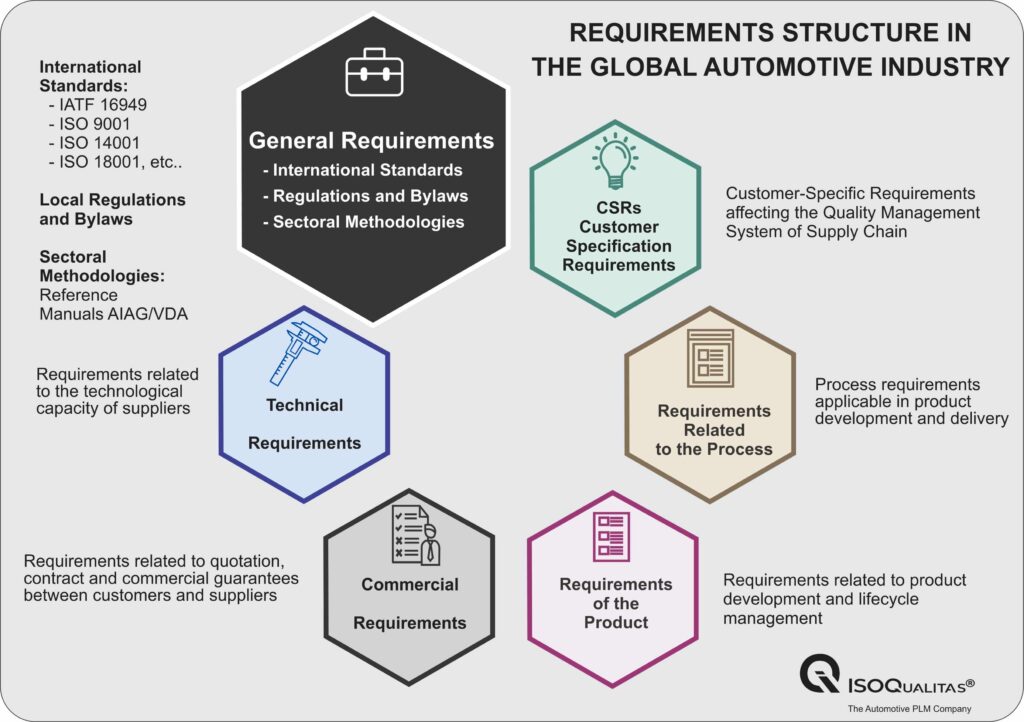
Customer-Specific Requirements are specific requirements established by customers in the automotive chain that complement or establish particularities for the application of quality management system requirements, especially in the context of IATF 16949.
These requirements may define additional conditions related to the application of methodologies, responsibilities, approvals, records, audits, indicators, and other aspects of quality management.
It is important to distinguish the CSRs associated with the quality management system from other customer requirements, such as drawings, engineering specifications, logistics requirements and commercial conditions.
While all applicable requirements need to be considered by the organization, not all of them formally fall under CSR related to IATF 16949.
Identifying this difference helps define how each requirement should be analyzed, implemented, and monitored.
What is the relationship between CSR and IATF 16949?
IATF 16949 establishes requirements for quality management systems applicable to the automotive industry, in conjunction with ISO 9001.
CSRs complement this structure by considering the specific requirements set by the customers applicable to the organization.
This means that meeting IATF 16949 does not eliminate the need to verify which specific customer requirements must be met.
An organization may supply components to different customers and need to consider different requirements for certain processes, documents, or activities.
Vehicle manufacturers that establish CSRs include Ford, General Motors, Renault, Stellantis, Volkswagen and BMW, among others.
However, the documents, their revisions and application conditions may vary.
Therefore, the organization must identify the requirements effectively applicable to its supply relationship, considering the documents in force and the other conditions established by the customer.
Why does CSR management require attention?
One of the main difficulties lies in the distribution of information.
Requirements may be present in specific documents, supplier portals, manuals, procedures, communications, and updates made available by customers.
In addition, the same supplier can serve different customers, each with their own requirements.
Consider an organization that supplies components to three automotive customers.
Even when using similar manufacturing processes, it may need to meet different conditions related to product approval, documentation, communication, monitoring, or application of Core Tools.
If these differences are not identified and directed to the responsible areas, situations such as the following may occur:
- using an outdated revision of a requirement;
- applying an internal procedure that does not include a specific requirement;
- lack of the evidence needed to demonstrate compliance;
- failures in communicating changes;
- divergences between development documents and production controls;
- non-conformities identified during customer audits or assessments.
Therefore, CSR management needs to go beyond document storage.
It is necessary to transform the applicable requirements into verifiable activities, responsibilities, controls and evidence.
How to identify and manage customer-specific requirements?
CSR management can be organized into steps that allow you to monitor each requirement from its identification to proof of compliance.
1. Identify customers and applicable documents
The first step consists of identifying the customers served and the documents that establish specific requirements applicable to the organization.
This identification should consider the official sources made available by customers and, where applicable, the documents published on the IATF portal.
It is also necessary to check:
- document identification and revision;
- effective date;
- units, products or processes covered;
- specific conditions of application;
- supplementary documents;
- responsibilities for following up on updates.
The objective is to ensure that the analysis is carried out based on correct and current information.
2. Analyze the requirements and their applicability
After identification, each requirement must be technically analyzed.
Not all requirements in a document will necessarily have the same application across all organizations, products, or processes.
The analysis must consider the activity carried out, the supplier’s position in the supply chain, the contracted scope and the conditions established by the customer.
The team needs to understand what the requirement dictates, where it applies, and what evidence will be needed to demonstrate compliance.
This evaluation may involve professionals from Quality, Engineering, Processes, Production, Logistics, Commercial and other related areas.
3. Relate requirements to internal processes
After defining the applicability, it is necessary to identify which processes or documents of the organization are impacted.
A requirement related to product approval, for example, may affect APQP activities, the preparation of PPAP documentation, and those responsible for customer submissions.
A requirement on manufacturing controls may require evaluation of the PFMEA, the Control Plan, the Reaction Plans, or the Work Instructions.
The important thing is that the requirement ceases to exist only in an external document and becomes related to the internal processes responsible for meeting it.
4. Define responsibilities and evidence of compliance
The organization shall establish who is responsible for implementing and maintaining each applicable requirement.
It also needs to identify the evidence necessary to demonstrate compliance.
Depending on the requirement, this evidence may involve:
- procedures and instructions;
- review and approval records;
- product and process development documents;
- study results and evaluations;
- production and quality records;
- evidence of customer communication;
- audit results;
- history of revisions and changes.
The existence of a document, by itself, does not necessarily prove that the requirement is being met.
It is necessary to verify its effective application.
5. Monitor revisions and assess impacts
Customer-specific requirements can be updated over time.
When a new revision is made available, the organization must evaluate what has changed and whether the change impacts its processes.
This analysis needs to identify which documents, controls, responsibilities, or records should be reviewed.
It is also important to keep track of changes and of decisions related to applicability.
Revision control, therefore, should not be limited to the customer’s document. It should reach the internal processes impacted by the change.
How do CSRs relate to Core Tools?
Core Tools are used in an integrated way in the development, approval and control of automotive products and processes.
Customer-specific requirements may establish additional conditions for their application.
Therefore, CSR management must consider the relationships between the applicable requirements and the tools used by the organization.
During APQP, the applicable requirements need to be considered in the planning and definition of development activities.
A specific requirement can influence deliverables, approval criteria, responsibilities or moments of evaluation with the customer.
The application of DFMEA and PFMEA must consider the requirements applicable to the product and process.
Depending on the customer’s requirements, there may be specific conditions related to the methodology, approval, review or presentation of the analyses.
Special characteristics and their controls must also be properly related to the applicable documents.
The Control Plan establishes the controls used to monitor product characteristics and process parameters.
Customer requirements may influence certain control conditions, frequencies, records, approvals, and Reaction Plans.
These requirements need to be evaluated alongside the information from the PFMEA and the manufacturing process.
MSA allows you to assess the adequacy of the systems used to obtain reliable data.
Where there are specific criteria established by the customer, they need to be considered in the planning and evaluation of the applicable studies.
The applicable requirements may influence monitoring, evaluation and reaction criteria related to the statistical behavior of the process.
It is necessary to ensure that the methods used are aligned with the relevant requirements.
PPAP gathers evidence that the applicable engineering requirements and specifications have been understood and that the process is able to produce according to the established requirements.
Customers can define specific conditions related to elements, submission levels, presentation methods, and approvals.
Therefore, the organization needs to check the applicable requirements before preparing and submitting documentation.
Core Tools should not be treated as stand-alone activities. Changes in customer requirements may impact different tools and related documents.
Practical example: changing a customer-specific requirement
Consider an automotive supplier that manufactures metal components used in vehicle assemblies.
While analyzing a new revision of a given customer’s applicable requirements, the team identifies a change in the approval criteria for process-related documentation.
The change requires reviewing previously defined documents and responsibilities.
The organization then needs to:
- Identify the changed requirement and its effective date.
- Verify applicability to the products and processes supplied.
- Identify the impacted documents and activities.
- Define those responsible for the adjustments.
- Update internal documents when necessary.
- Perform the required approvals.
- Record the implementation evidence.
- Verify that the processes now meet the new condition.
If the change involves the PFMEA and the Control Plan, for example, it is not enough to update a requirements record.
It is necessary to evaluate the applicable revisions, approvals, relationships with Work Instructions and the controls actually used in production.
This example illustrates the importance of maintaining traceability between customer requirements, applicability analysis, impacted documents, actions, and evidence of compliance.
What happens when a customer-specific requirement is not met?
Failure to meet an applicable requirement may lead to a non-conformity, even when the product meets its dimensional or functional specifications.
This is because compliance also involves meeting the requirements pertinent to the management system, the processes, and the supply relationship.
When a non-conformity is identified, the organization must assess its extent, potential impacts, and the need for action.
Depending on the situation, a structured investigation through Global 8D may be required, especially when the customer requires it or an in-depth analysis is needed.
The investigation may reveal, for example:
- a requirement that was not identified;
- a revision not incorporated into the internal procedure;
- communication failures between areas;
- no defined responsibility;
- deficiencies in verifying compliance;
- insufficient evidence of implementation.
Corrective actions must consider not only the occurrence, but the causes that allowed the requirement not to be met.
Where applicable, learnings should be incorporated into related processes and documents.
Main challenges in managing CSRs
Some difficulties may compromise the effectiveness of this management.
Keeping only a collection of documents: archiving requirements does not guarantee their analysis or implementation.
Not assessing applicability: the organization may fail to comply with relevant requirements or apply conditions that do not match its scope.
Lack of follow-up on revisions: changes made available by customers may not reach the impacted processes.
Lack of responsibilities: identified requirements may remain without a defined implementation.
Disconnected documents: a change can be incorporated into a procedure, but not into the PFMEA, the Control Plan, or the Work Instructions, when such revisions are required.
Not verifying the effectiveness of the implementation: completing an administrative activity does not prove compliance with the requirement in the actual process.
These difficulties demonstrate the importance of keeping requirements connected to the information that guides and evidences their application.
How can an integrated system support CSR management?
Managing customer-specific requirements requires technical analysis, interpretation of applicable documents, and definition of responsibilities by the organization.
An integrated system does not replace these activities or determine by itself which requirements are applicable to each supply relationship.
However, it can support the organization and traceability of requirements-related information.
ISOQualitas PLM can contribute to keeping product and process information integrated, supporting activities such as:
- document and revision management;
- identification of information related to applicable requirements;
- relationship between product and process documents;
- product and process characteristics management;
- integration between PFMEA and Control Plan;
- traceability of changes;
- follow-up of actions;
- maintaining the history of the analyses;
- integration of information related to Core Tools.
In this way, the organization can use the information from customer requirements as a reference to assess impacts and keep related documents and controls up to date.
The benefit of integration is not only in storing information, but in reducing the risk of divergences between the requirements identified, the approved documents and the processes actually executed.
Conclusion
The management of CSRs is an important activity to ensure compliance with the specific requirements applicable to suppliers in the automotive industry.
Its goal should not be limited to identifying the documents required by customers.
It is necessary to assess applicability, define responsibilities, incorporate requirements into processes, monitor revisions, and maintain evidence of compliance.
This management also needs to consider integration with Core Tools and other documents used in development and manufacturing.
When customer-specific requirements, product information, processes, controls, and changes are managed in an integrated and traceable manner, the organization strengthens consistency between what has been required and what is actually being done.
ISOQualitas PLM supports the integrated management of product and process information, contributing to the traceability of changes and the maintenance of relationships between risks, controls, documents and Core Tools throughout the life cycle.
Recent Posts
Archive
Categories
Categories
- APQP and Core Tools (4)
- APQP e Core Tools (3)
- Automotive Audits (2)
- Automotive Cybersecurity (1)
- Automotive Digital Transformation (1)
- Automotive Process Engineering (2)
- Automotive Quality and Compliance (1)
- Automotive Quality Management (8)
- Automotive Risk and Quality Management (1)
- Blog (3)
- Digital Transformation in Industry (6)
- Engenharia de Processos Automotivos (3)
- Engenharia de Produto e Processos (3)
- Engineering and Quality (1)
- ESG in the Automotive Sector (1)
- Future of Work (1)
- Gestão da Qualidade Automotiva (2)
- IATF 16949 (3)
- IATF 16949 Compliance (1)
- Industrial Automation (2)
- Industrial Efficiency (1)
- Industrial Technology and PLM (2)
- Industry 4.0 (2)
- Manufacturing Software Solutions (1)
- News (20)
- Nonconformity Reduction (1)
- Product and Process Engineering (4)
- Product Development and Engineering (3)
- Product Lifecycle Management (2)
- Product Lifecycle Management (PLM) (4)
- Qualidade Automotiva (3)
- Qualidade e Controle Estatístico de Processos (3)
- Quality and Compliance Management (1)
- Quality and Technology (2)
- Quality Management (4)
- Quality Management in Industry (1)
- Recall Prevention (1)
- Risk Analysis and Corrective Actions (1)
- Software-Defined Vehicles (SDVs) (1)
- Statistical Process Control and Quality (1)
- Sustainability in Industry (1)
- Technological Transformation (2)
Tags
Tags
8D automotive industry
automotive 8D
Automotive APQP
automotive compliance
automotive core tools
automotive cybersecurity
automotive FMEA
automotive industry
automotive nonconformities
automotive PLM
automotive ppap
automotive product engineering
automotive product lifecycle
automotive quality
automotive quality software
automotive risk management
automotive spc
automotive standards
automotive traceability
corrective and preventive actions
dfmea pfmea
Digital automotive compliance
digital automotive engineering
digital FMEA
Digital transformation in manufacturing
engineering change management
Global 8D
IATF 16949
IATF 16949 compliance
industrial digital transformation
industrial erp
Industrial production optimization
industrial risk management
Industry 4.0 and quality
ISOQualitas PLM
pfmea
problem solving
process traceability
product lifecycle management
product traceability automotive
quality management software
quality management system
quality management system qms
root cause analysis
training for digital era