
Menu

Global 8D in the Automotive Industry: how to structure the problem-solving process and avoid the recurrence of non-conformities
In the automotive industry, identifying and containing non-conformance is only the beginning of solving a problem.
When a fault reaches the customer, which was not detected during production or has a recurrence, it is necessary to understand why it occurred, why it was not previously detected and what needs to be changed to prevent it from happening again.
It is in this context that Global 8D (8 Disciplines) is used.
It is a structured problem-solving methodology based on the work of a multidisciplinary team, the identification and verification of causes, and the implementation of corrective actions to prevent recurrence. Its use is widely spread in the automotive chain.
More than filling out a report, Global 8D establishes a logical sequence to lead the organization from the identification of the problem to its solution and incorporation of the learnings into the related processes.
What is Global 8D?
Global 8D organizes the problem-solving process into successive disciplines, usually starting with a preparation stage, called D0, followed by disciplines D1 to D8.
Logic can be summarized as:
Problem → Customer Protection → Investigation → Root Cause → Corrective Action → Validation → Prevention of Recurrence → Termination
Each discipline has a specific purpose, preventing the organization from moving directly towards a solution without properly understanding the problem.
This is especially important because fixing the product does not necessarily mean fixing the cause that generated the failure.
A 100% selection or inspection, for example, may temporarily prevent non-conforming parts from reaching the customer, but it does not necessarily eliminate the condition responsible for generating the non-conformity.
Global 8D is a methodology that uses several auxiliary tools in each of the 8 disciplines for effective problem solving.
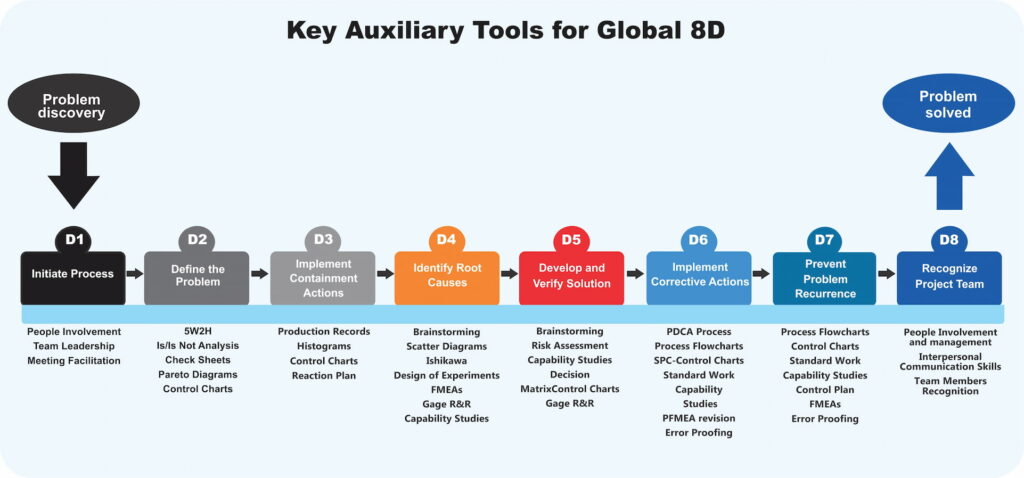
When to use Global 8D?
Not every occurrence necessarily needs a complete Global 8D process.
The methodology is especially applicable when the problem requires structured research, involvement of different areas and proof of the effectiveness of the actions.
It can be used, for example, in situations involving:
- Customer complaints;
- Relevant non-conformities;
- Recurring Failures;
- Field or warranty issues;
- Impact on special Characteristics;
- Failures with significant impact on the product or process;
- Problems whose cause is not immediately known;
- Situations in which the customer requests a specific troubleshooting methodology.
Specific customer requirements also need to be considered. IATF 16949 provides that when the customer prescribes specific processes, tools, or systems for troubleshooting, the organization must use them, unless otherwise approved by the customer.
D0 – Prepare and plan the response to the problem
Before the investigation process is fully formed, it is necessary to understand the initial situation and assess the need for an immediate response.
D0 may involve:
- Collection of the first information;
- Assessing the extent and impact of the problem;
- Identification of potentially affected products;
- Definition of emergency actions;
- Immediate customer protection;
- Decision on the need to open a Global 8D.
At this point, the goal is not yet to definitively determine the root cause, but to control the situation and properly structure the investigation.
D1 – Build the team
Complex problems should rarely be analyzed by a single area.
D1 establishes a multidisciplinary team with knowledge about the product, process and problem analyzed.
Depending on the occurrence, professionals from the areas of:
Quality → Engineering → Production → Processes → Maintenance → Logistics → Suppliers → other related areas
The composition must consider the competencies necessary to technically investigate the occurrence and implement the necessary actions.
It is also important to establish responsibilities and leadership to conduct the process.
D2 – Describe the problem
Effective investigation depends on a precise definition of the problem.
Expressions such as “defective part”, “assembly problem” or “dimension outside” are insufficient to guide a root cause analysis.
The description should use facts and evidence.
Tools such as 5W2H and Is/Is Not analysis can help narrow down the occurrence.
It is important to understand issues such as:
- What happened?
- Where it was identified?
- When it occurred?
- What product, component, process, or operation is involved?
- What is the amount affected?
- Which batches or periods can be related?
- Where does the problem occurs and where it does not occur?
The clearer the definition, the greater the team’s ability to correctly direct the investigation.
D3 – Implement containment actions
While the root cause is still being investigated, it is necessary to prevent the issue from continuing to impact the customer or moving forward through the process.
Containment actions are then established.
Depending on the situation, they may involve:
- Inventory blocking;
- Materials segregation;
- Additional inspection;
- Product selection;
- In-process product verification;
- Identification of potentially affected batches;
- Inspection of materials in transit or customer inventory, where applicable;
- Additional temporary controls.
Containment needs to consider the scope of the problem and its traceability.
In addition to implementing the action, it is necessary to verify that it is effectively protecting the customer and preventing new escapes.
And there is a fundamental distinction:
Containment is not a permanent corrective action.
Containment temporarily controls the effect or prevents its spread while the cause is investigated.
D4 – Identify and verify the root cause and escape point
D4 is one of the most important stages of Global 8D.
The team investigates the possible causes and uses evidence to determine which of them effectively explains the problem.
Tools such as:
5 Whys, Ishikawa diagram, process analysis, condition comparison, testing, measurements, and data analysis.
But there is one particularly important aspect of Global 8D: It is not enough to understand why the defect occurred. It is also necessary to understand why it was not detected before reaching the point where it was identified.
Thus, the investigation must consider both the cause of the occurrence and the point of escape.
The escape point represents a control opportunity where the problem could have been identified but was not.
Por exemplo:
Why was the dimension out of specification? → investigation of the cause of the occurrence.
Why didn’t the existing control system identify the part out of specification? → investigation of the escape point and detection effectiveness.
This distinction prevents the organization from correcting only what generated the failure without also evaluating the deficiency that allowed it not to be detected.
Root cause should not be confused with symptom
One of the risks during a root cause analysis is stopping the investigation too soon.
Conclusions such as: “operator error”, “inspection failure”, “incorrect parameter” may describe what happened, but still not necessarily explain why the system allowed it to happen.
If a parameter was incorrect, for example, the investigation may need to move forward:
Why was it incorrect?
The parameter was defined?
Was there any lock or error-proof system?
The work instruction was up to date?
The operator had access to the correct overhaul?
An earlier change was properly incorporated into the process?
The goal of the analysis is to arrive at causes technically supported by evidence, not just to find one possible explanation.
D5 – Select and check the permanent corrective actions
Once the causes are verified, the team must determine what actions can eliminate them.
Permanent corrective actions need to be related to the identified causes.
They must also be evaluated for their feasibility and possible effects on the product and process.
Where applicable, tests, studies or evaluations may be carried out prior to definitive implementation to verify that the proposed action actually eliminates the cause without introducing new risks.
D6 – Implement and validate permanent corrective actions
In D6, the selected actions are implemented in the process.
This may involve, for example:
- Process changes;
- Process parameters changes;
- Changes to equipment or devices;
- Implementation of error-proofing systems;
- Product Changes;
- Review of control methods;
- Updating Work Instructions;
- Training related to the changes made.
After implementation, it is necessary to monitor the results and obtain evidence that the actions are effective.
The removal of temporary containments should occur in a controlled manner, after the organization has adequate evidence that permanent actions have been implemented and are effective.
D7 – Prevent recurrence
Solving the specific occurrence still does not completely end the learning.
D7 extends analytics to the system.
The team should evaluate whether the knowledge obtained can impact:
PFMEA → Control Plan → Process Flow Diagram → Work Instructions → Similar Processes → Similar Products
IATF 16949 rightly establishes the need to consider the impact of systemic corrective actions on similar products and processes, and to review and update appropriate documented information, such as PFMEA and Control Plan, when necessary.
This is where Global 8D connects directly to previous ISOQualitas articles.
If a new cause of failure has been discovered, it may need to be incorporated into FMEA in the automotive industry: how to structure DFMEA and PFMEA according to APQP and IATF 16949 standard.
If a problem of prevention or detection controls has been identified, the Control Plan should be reviewed.
If the actual process did not match the documented process, the results can also feed into future checks in R-FMEA (Reverse FMEA): How to verify that the controls defined in PFMEA are actually applied in the process.
The solution to the problem thus generates knowledge for risk management.
D8 – Recognize the team and close the process
The last discipline involves formally terminating the problem-solving process.
The team should verify that the planned actions have been completed, that there is evidence of effectiveness, and that related documents have been updated where applicable.
Global 8D also includes recognizing the team’s contribution and sharing the lessons learned.
Termination should not occur simply because all actions have been given a status of “completed”.
Implemented action does not necessarily mean effective action.
The closure must be supported by evidence that the problem was adequately addressed and that the actions produced the expected result.
Global 8D, PFMEA, Control Plan, and R-FMEA: How This Information Connects?
Problem-solving should not work in isolation from risk management.
We can view this integration as follows:
Internal or External Non-Conformity – Customer Complaint
↓
Opening of the Global 8D process
↓
Containment → Root Cause + Escape Point → Corrective Action → Effectiveness Check
↓
Learning
↓
Update of PFMEA → Control Plan → Reaction Plans → Work Instructions → other applicable documents
↓
Manufacturing Process
↓
R-FMEA
↓
Verification in the actual process
This integration creates an important cycle.
PFMEA anticipates risks.
The Control Plan transforms the relevant risks and characteristics into controls applicable to production.
Production performs the defined controls.
R-FMEA verifies that what was planned corresponds to the reality of the process.
And when a non-conformity occurs, Global 8D structures the investigation, correcting the causes, and incorporating the learning back into the system.
Major flaws in the application of Global 8D process
Even a structured methodology can lose effectiveness when used only as a form.
Among the most common problems are:
Insufficient description of the problem: hinders the rest of the investigation.
Confusing containment with definitive solution: An additional inspection may protect the customer, but it does not necessarily eliminate the cause.
Defining root cause without evidence: a hypothesis should not be treated as proven cause.
Stop the analysis on “human error”: it is necessary to investigate the process and system conditions that allowed the error.
Not investigating the escape point: correcting the occurrence without understanding why it was not detected maintains a weakness in the process.
Implementing an action without verifying its effectiveness: completing an activity does not prove that the problem has been eliminated.
Not updating PFMEA, Control Plan and related documents: learning is restricted to the 8D report.
Not evaluating similar processes and products: the opportunity to transform corrective action into systemic learning is lost.
How an integrated system can support the Global 8D process?
The Global 8D relies on technical analysis performed by a multidisciplinary team. An integrated system is no substitute for investigation, root cause analysis or decision-making.
However, it can support the management of the information generated throughout the process.
ISOQualitas PLM can contribute to keeping related information such as:
- Non-conformities and complaints;
- Containment actions;
- Responsible and deadlines;
- Analysis of the causes;
- Evidence;
- Corrective actions;
- Effectiveness check;
- Product and process changes;
- PFMEA;
- Control Plan;
- Revision and History Information.
This helps preserve traceability between problem → cause → action → change → control, preventing learning from remaining siloed in independent reports, spreadsheets, or documents.
In the same way that we observed in R-FMEA, the goal is not just to record an activity, but to keep the related information up to date throughout the product and process lifecycle.
Conclusion
Global 8D structures problem-solving to move the organization beyond immediate reaction to non-compliance.
The methodology leads the team from customer protection to the investigation of the causes, implementation of corrective actions, verification of effectiveness and prevention of recurrence.
Its greatest value is precisely in transforming an occurrence into learning.
When the conclusions of the Global 8D feed back into the PFMEA, the Control Plan, the Work Instructions and other related information, the organization strengthens risk management and reduces the possibility of facing known problems again.
ISOQualitas PLM supports this integration by connecting product, process, risk, controls, non-conformances, actions, and changing information in a structured, traceable environment.
Posts Recentes
Arquivos
Categorias
Categories
- APQP and Core Tools (4)
- APQP e Core Tools (2)
- Automotive Audits (2)
- Automotive Cybersecurity (1)
- Automotive Digital Transformation (1)
- Automotive Process Engineering (2)
- Automotive Quality and Compliance (1)
- Automotive Quality Management (8)
- Automotive Risk and Quality Management (1)
- Blog (2)
- Digital Transformation in Industry (6)
- Engenharia de Processos Automotivos (2)
- Engenharia de Produto e Processos (2)
- Engineering and Quality (1)
- ESG in the Automotive Sector (1)
- Future of Work (1)
- Gestão da Qualidade Automotiva (2)
- IATF 16949 (3)
- IATF 16949 Compliance (1)
- Industrial Automation (2)
- Industrial Efficiency (1)
- Industrial Technology and PLM (2)
- Industry 4.0 (2)
- Manufacturing Software Solutions (1)
- News (20)
- Nonconformity Reduction (1)
- Product and Process Engineering (4)
- Product Development and Engineering (3)
- Product Lifecycle Management (2)
- Product Lifecycle Management (PLM) (4)
- Qualidade Automotiva (2)
- Qualidade e Controle Estatístico de Processos (2)
- Quality and Compliance Management (1)
- Quality and Technology (2)
- Quality Management (4)
- Quality Management in Industry (1)
- Recall Prevention (1)
- Risk Analysis and Corrective Actions (1)
- Software-Defined Vehicles (SDVs) (1)
- Statistical Process Control and Quality (1)
- Sustainability in Industry (1)
- Technological Transformation (2)
Tags
Tags
audit checklist
automation and productivity
Automotive APQP
automotive core tools
automotive cybersecurity
automotive FMEA
automotive nonconformities
automotive PLM
automotive PLM solution
automotive ppap
automotive product engineering
automotive quality
automotive quality software
automotive risk management
automotive spc
automotive traceability
connected vehicles
Control Plan
corrective and preventive actions
cyber risk management
dfmea pfmea
digital FMEA
engineering change management
ESG in the automotive industry
Global 8D
IATF 16949
IATF 16949 compliance
industrial digital transformation
industrial erp
Industrial process integration
industrial risk management
industrial sustainability
Industry 4.0 and quality
ISOQualitas automation solutions
ISOQualitas PLM
ISO quality standards
nonconformance management
pfmea
process capability
process traceability
product lifecycle management
quality management system
quality management system qms
root cause analysis
SDV in automotive industry